
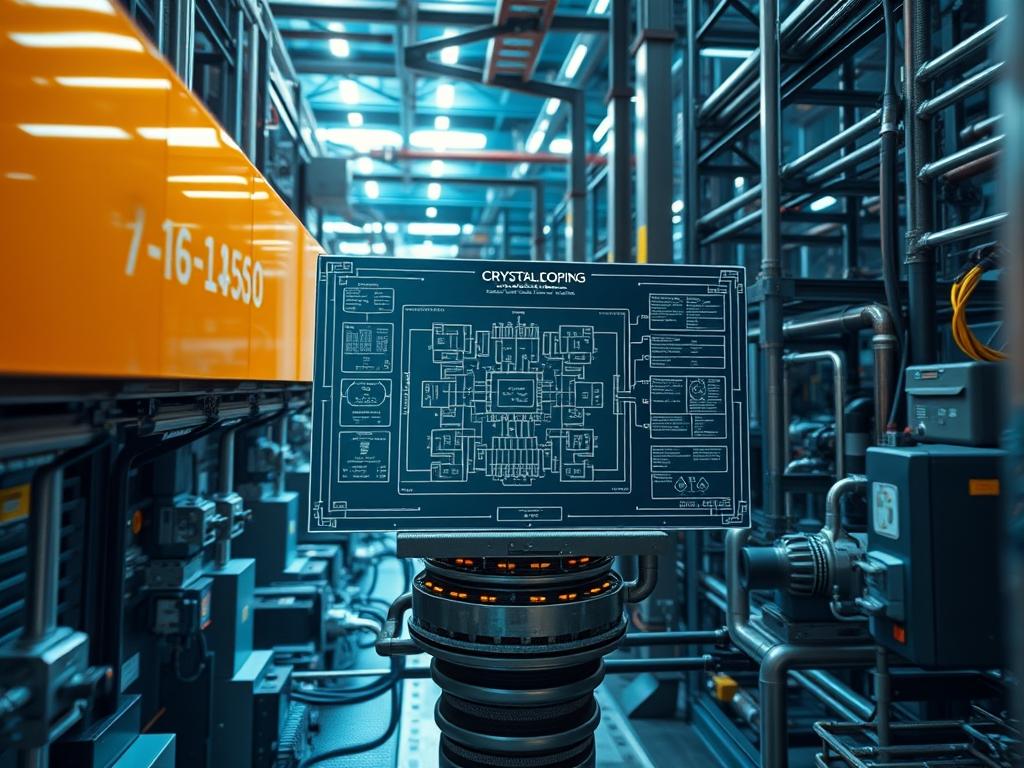
Crystal Lattice Doping represents the fundamental refinement of semiconductor substrates to ensure structural and electrical idempotency within critical infrastructure. Whether managing the power distribution of a municipal energy grid or facilitating the high-frequency switching of a regional cloud architecture; the integrity of the crystal lattice dictates the upper limits of system performance and reliability. Traditional manufacturing methods often suffer from uncontrolled impurities that introduce parasitic capacitance and signal-attenuation; which ultimately manifest as jitter in high-speed data paths or thermal runaway in power converters. This manual outlines the protocol for targeted doping: the precise introduction of specific impurities into a crystal host to modify its electrical and mechanical characteristics with mathematical precision. By refining the lattice, systems architects can significantly reduce thermal-inertia and improve the throughput of high-power switching components. This process is essential for mitigating packet-loss in optical interconnects and maintaining voltage stability under high-load concurrency environments. The solution involves vacuum-sealed environments; ion-beam control systems; and algorithmic thermal regulation; all working in tandem to harden the physical layer against degradation.
TECHNICAL SPECIFICATIONS
| Requirement | Operating Range | Protocol/Standard | Impact Level (1-10) | Recommended Resources |
| :— | :— | :— | :— | :— |
| Substrate Purity | 99.999% to 99.9999% | SEMI M1-0302 | 10 | Ultra-Pure Silicon (9N) |
| Ion Injection Flux | 1.0E11 to 1.0E16 ions/cm2 | IEEE 1588-2019 | 8 | High-Current Implanter |
| Thermal Stability | -40C to +155C | AEC-Q100 Grade 0 | 9 | Nitrogen Cooling Loop |
| Controller Latency | < 500 Microseconds | Real-Time Linux | 7 | 32GB RAM / Octa-Core |
| Logic Voltage | 1.8V / 3.3V / 5.0V | JEDEC JESD8-5A | 6 | Low-Drift LDO Regulators |
| Vacuum Pressure | 1.0E-7 to 1.0E-9 Torr | ISO 3567 | 8 | Cryogenic Vacuum Pump |
THE CONFIGURATION PROTOCOL
Environment Prerequisites:
Before initiating the Crystal Lattice Doping procedure; the environment must meet stringent isolation standards to prevent external contaminants from introducing overhead into the reaction chamber. The primary controller must be running a hardened Linux distribution; specifically Debian 11 or RHEL 8; with the PREEMPT_RT patch applied to ensure deterministic process execution. Users must possess root level permissions or reside within the sudo and dialout groups to interface with hardware drivers. Hardware dependencies include a calibrated HP-8116A pulse generator and a Fluke-1587 insulation tester; verified within the last six months of operation. All network interfaces must be configured with a static IPv4 address; and unnecessary services such as avahi-daemon or cups must be disabled to minimize interrupt jitter.
Section A: Implementation Logic:
The engineering design of targeted doping hinges on the concept of substitutional replacement within the host lattice. By bombarding the substrate with a controlled payload of ions; we disrupt the native bonds and insert dopants that either provide free electrons (n-type) or create holes (p-type). This modification reduces the electrical resistance and manages the thermal-inertia of the material; allowing for faster transitions between logic states without significant heat accumulation. The logic is idempotent; meaning that repeated applications of the thermal annealing cycle under the same parameters will yield a stable and predictable lattice structure. This consistency is vital for scaling high-density compute clusters where thousands of micro-components must perform synchronously without localized failures.
Step-By-Step Execution
1. Chamber Decontamination and Vacuum Initialization
Execute the command vacuum-ctl –init –target 10-8 to engage the primary turbomolecular pumps. Monitor the readout via sensors.
System Note: This action purges the atmospheric payload within the reaction chamber; preventing oxygen and nitrogen from reacting with the substrate during the high-energy phase. It ensures that the only ions present are those intended for the doping process; thereby reducing potential signal-attenuation in the final product.
2. Substrate Alignment and Mechanical Locking
Utilize the industrial-logic-controller (ILC) to position the substrate on the electrostatic-chuck. Verify alignment using the command align-check –precision 0.001mm.
System Note: Proper alignment is crucial for ensuring the ion beam hits the target area at a perpendicular angle. Misalignment causes uneven distribution of the dopant; leading to localized “hot spots” where thermal-inertia exceeds the cooling system’s capacity; potentially bricking the hardware.
3. Ion Source Ignition and Flux Calibration
Issue the command ion-gen –start –gas-source=phosphine. Adjust the beam current using modprobe ion_driver beam_current=500mA.
System Note: This step initializes the plasma source that generates the doping ions. The kernel driver maps the hardware pulse-width modulation (PWM) to the beam intensity; allowing the software layer to control the exact density of ions being delivered to the lattice.
4. Implantation Phase and Real-Time Monitoring
Run the process script ./start_doping_sequence.sh –duration=3600 –energy=80keV. Monitor the system logs via tail -f /var/log/doping_process.log.
System Note: During this hour-long execution; the ions penetrate the crystal surface. The system’s background tasks must minimize concurrency during this time to prevent any micro-stutter in the beam steering hardware; which could lead to lattice defects and increased packet-loss in the final circuit interconnects.
5. Rapid Thermal Annealing (RTA)
Execute thermal-ctl –ramp 100C/s –target 1050C. Once the target is reached; maintain for 30 seconds before initiating the quench phase with coolant-init –medium=nitrogen.
System Note: Annealing is the most critical recovery phase. The high heat allows the displaced atoms to migrate back into a stable lattice formation around the new dopant ions. This reduces the mechanical stress within the substrate and lowers the electrical overhead of the component.
6. Post-Process Metric Validation
Run the diagnostic suite lattice-verify –full-scan. This tool interfaces with an external oscilloscope and spectrometer to measure the effective mobility of electrons.
System Note: This final check confirms the modification’s success. It measures the throughput of test signals across the doped area. If the signal-attenuation is within the specified 0.2dB range; the process is considered successful.
Section B: Dependency Fault-Lines:
Failures in this protocol typically stem from library version mismatches or mechanical sensor drift. If the libusb-1.0 library is not correctly linked; the ion-gen command will fail with a “Device Not Found” error. Mechanical bottlenecks often occur in the cooling manifold; where calcification can restrict flow and cause a failure in the thermal-inertia management system. Always verify that the systemd-timesyncd service is active; as timestamp accuracy is required for correlating logs between the controller and the vacuum sensors.
THE TROUBLESHOOTING MATRIX
Section C: Logs & Debugging:
When a fault occurs; the first point of inspection is the kernel ring buffer accessible via dmesg | grep “ion-driver”. A typical error string such as “ERR_BEAM_INSTABILITY_0xF4” indicates a power supply fluctuation or a gas delivery blockage. For thermal issues; consult the history at /var/lib/thermal-data/history.csv to identify the exact moment the ramp rate diverged from the setpoint.
If the system reports high latency in process response; check the CPU frequency scaling governor with cat /sys/devices/system/cpu/cpu*/cpufreq/scaling_governor. It must be set to “performance” to prevent the processor from entering a low-power state during a critical doping window. Physical visual cues; such as a purple hue in the plasma chamber; indicate nitrogen leakage. If the plasma appears bright white; the vacuum integrity has been compromised; requiring an immediate abort via the emergency-stop physical button.
OPTIMIZATION & HARDENING
Performance Tuning
To improve throughput in a production environment; architects should implement batch processing. By utilizing a multi-wafer-arm; the idle time between vacuum cycles is reduced. Further optimization of the PREEMPT_RT kernel parameters; such as setting the threadirqs flag; allows the ion implanter’s interrupt handler to take priority over all non-essential background tasks. This reduces the jitter in the ion flux and ensures a more uniform lattice distribution.
Security Hardening
Physical and digital security are paramount. The control network must be air-gapped from the primary corporate network to prevent unauthorized access to the PLC (Programmable Logic Controller). Implement firewalld on the controller; allowing only incoming traffic on local ports used by the SCADA interface. Ensure all process scripts are owned by root with permissions set to 700; preventing non-privileged users from modifying the doping energy parameters.
Scaling Logic
Scaling the Crystal Lattice Doping process requires a modular approach. Instead of a single massive chamber; maintain a farm of smaller; independent units controlled by a centralized Kubernetes cluster. Each “node” represents a doping chamber. This architecture ensures that a single failure in the vacuum pump of one unit does not result in total system downtime. By using Prometheus for monitoring and Grafana for visualization; administrators can track the health of the entire doping fleet in real-time.
THE ADMIN DESK
What is the primary cause of signal-attenuation after doping?
Attenuation is often caused by incomplete annealing. If the thermal-inertia of the substrate is not properly managed during the cooling phase; localized lattice defects remain; trapping electrons and slowing signal propagation across the doped region.
How do I fix the “Permission Denied” error on /dev/ttyUSB0?
Ensure your user is part of the dialout and uucp groups. Run sudo usermod -aG dialout $USER; then logout and log back in to apply the group permissions required to talk to the hardware.
Can this process be applied to Gallium Nitride?
Yes; however; the thermal ramp rates must be adjusted. Gallium Nitride has a different thermal-inertia profile than Silicon. Use the –substrate=GaN flag in your configuration scripts to load the appropriate voltage and temperature profiles.
Why is my vacuum pressure stuck at 10-6 Torr?
Check the O-rings for microscopic cracks. At high-vacuum levels; even a single human hair on a seal can prevent the system from reaching the 10-8 Torr threshold required for ultra-pure crystal lattice doping.
What is the effect of packet-loss in this physical context?
While “packet-loss” is traditionally a networking term; in lattice engineering it refers to the loss of charge carriers. High impurities create electron traps that prevent the payload from reaching its destination; effectively mimicking data loss in a digital transmission.